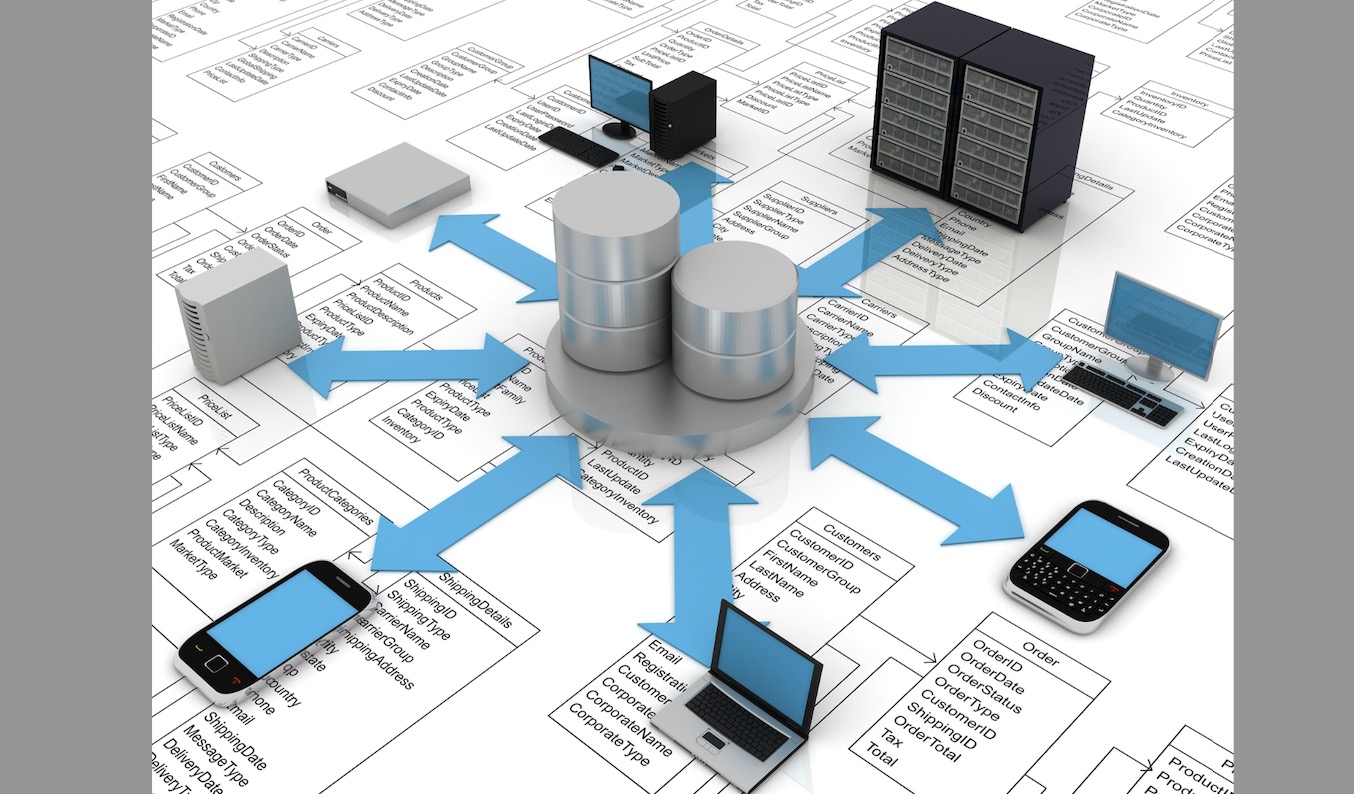
In today’s software industry, databases form the backbone of digital infrastructure. They not only store data, but also manage, organize, and query information—supporting the scalability and evolution of modern software systems. However, databases did not appear alongside the first software applications. Instead, the evolution of databases reflects decades of adaptation to growing data volume, complexity, and performance demands.
This article traces the evolution of databases from early file systems to modern AI-oriented architectures, highlighting how database technology has continuously reinvented itself while remaining a core component of computing.
The File System Era
Before databases existed—roughly prior to the 1960s—applications stored data directly in memory or on magnetic tapes. Each program defined its own file structure and access logic. As a result, data and application code were tightly coupled.
Consequently, systems suffered from poor scalability, limited reusability, and almost no querying capability. As data complexity increased, developers needed a more structured and reusable way to manage information. This need marked the beginning of database systems.
The Birth of the Database
The 1970s marked a major turning point in the evolution of databases. IBM researchers introduced the relational model, which represented data as tables and emphasized data independence—separating data from application logic.
Shortly after, SQL (Structured Query Language) emerged as a standardized way to manipulate and query data. Together, these innovations led to the rise of Relational Database Management Systems (RDBMS), laying the foundation for modern data management.
Commercialization and Proliferation
During the 1980s, relational databases gained significant traction and began to be commercialized across industries. Oracle released the first commercial RDBMS. IBM followed with DB2, and Microsoft introduced SQL Server. More and more enterprises adopted databases, accelerating their widespread adoption.
The Rise of Open Source
As commercial RDBMS products evolved and cemented their dominance, the market began to see the emergence of lightweight open-source alternatives that challenged this status quo.
Among them, MySQL and PostgreSQL became key players. MySQL gained popularity for its simplicity, ease of deployment, and cross-platform compatibility—making it a go-to solution for many small-to-medium internet companies. PostgreSQL, on the other hand, emphasized standard compliance, engineering rigor, a rich set of index types, support for complex data types, and robust transaction handling. As a result, it began to capture market share from MySQL and even shows signs of surpassing it.
The Rise of NoSQL
With the explosion of internet applications came the need to handle massive concurrent requests. Traditional relational databases struggled under high concurrency and large-scale data loads, paving the way for NoSQL databases. These databases offered more flexible data models and better horizontal scalability. Most of them were open-source and evolved rapidly with strong community support.
NoSQL databases generally fall into four categories:
- Key-value stores (e.g., Redis)
- Document stores (e.g., MongoDB)
- Column-family stores (e.g., HBase)
- Graph databases (e.g., Neo4j)
NoSQL systems trade off strict transactional guarantees in favor of flexibility, performance, and distributed capabilities—making them well-suited for big data scenarios. However, NoSQL doesn’t aim to replace relational databases; rather, it complements them.
NewSQL: Bridging the Gap
While NoSQL solved many scalability issues, it often sacrificed important features such as transactional consistency. This led to the emergence of NewSQL—databases that aim to combine the best of both relational databases and NoSQL. These systems support strong consistency, transactions, and scalability through innovative architectures.
A notable example is TiDB, which is MySQL-compatible, distributed in nature, and supports distributed transactions. TiDB has been widely adopted in various real-world scenarios.
The Rise of Vector Databases
In recent years, with the advancement of AI, large language models, and multimodal applications, traditional databases are no longer well-suited for managing and retrieving high-dimensional semantic vectors. This has led to the rise of vector databases in response to the unique demands of AI.
Vector databases aren’t typically used in conventional software systems. Instead, they serve specialized tasks like image search, real-time recommendation, and RAG (Retrieval-Augmented Generation) in deep learning applications. Representative products include Faiss by Meta and Milvus by Zilliz.
Future Trends
As application scenarios continue to evolve, so will databases. From relational databases to NoSQL, from NewSQL to vector databases—these technologies do not exist to replace one another. Each excels in specific domains and continues to evolve.
The future will likely see more hybrid database architectures, combining the strengths of multiple models—similar to what NewSQL has done. Furthermore, with the growing integration of AI, we may see the emergence of smarter, more secure, and more efficient next-generation databases.
Conclusion
From the relational model to vector databases, the database has evolved far beyond a simple data store. Understanding databases today isn’t just about writing SQL—it’s about recognizing their architectural roles and selecting the right solution for the right context.